The Science of Life Itself
VITALISM
The Vital Life Force Governs All Health and Disease
Vitalism is Western civilization’s science and philosophy of the life force in living beings, the principle through which life, health, symptoms, what is called disease, and healing are understood as expressions of the lawful activity of nature. It studies the intelligence by which a living being organizes and maintains itself, grows and reproduces, adapts and defends, conserves and repairs, and governs degeneration and restoration, together with the conditions that build, diminish, and restore vitality.
Any serious consideration of health and healing must begin with life itself. Before one can ask why the body becomes ill, produces symptoms, repairs tissue, adapts, or heals, one must first account for the living principle by which it does any of these things at all. A medicine that studies every structure, chemical, organ, mechanism, and symptom of the body while neglecting the vital life force begins its inquiry one step too late.
Origins
The Vitalist Tradition
Hippocrates, remembered as the father of Western medicine, stands at the beginning of the Western Vitalist tradition. His influence remains present more than two thousand years later in the Hippocratic tradition and in the oaths taken by physicians as they enter their profession. Hippocrates named the vital life force physis, the nature inherent within the living body, and recognized this nature as the physician in disease. He observed that physis possesses its own intelligence and finds the way toward preservation and healing through its own inherent order.
“The body’s nature [physis/vita] is the physician in disease. Nature finds the way for herself, not from thought. … Without instruction, Nature does what is needed.”
Hippocrates · Epidemics, VI.5.1 · c. 400 BCHippocrates’ recognition of this inherent ordering and healing principle became foundational to the Vitalist tradition. Western thought continued to express it through terms including pneuma, the vital breath; anima, the animating principle; and vis medicatrix naturae, the healing power of nature. Other civilizations developed their own languages and systems around the same fundamental observation. Chinese medicine names it Chi, and Ayurveda names it Prana. The vital life force is the most fundamental attribute of the living being and therefore the natural starting point whenever one thinks, speaks, studies, or practices in the realm of health and healing.
Vita, the Latin word for life and the root already present in vital, vitality, and vitals the doctor monitors, is the modern Western name for this living principle inherent to all living things.
Vitality is the strength and available expression of Vita.
The Science of Life Itself
The Vital Life Force
Vita is expressed through the functions of life. It governs growth, adaptation, defense, conservation, repair, regeneration, and restoration from within the living body.
Every one of these functions requires energy. At the biological level, this requirement can be followed into the mitochondria, where cellular respiration produces ATP, the immediately usable energy upon which cellular and bodily activity depends. Movement, thought, circulation, digestion, immune activity, detoxification, repair, and regeneration all draw upon the continual generation and expenditure of energy.
Mitochondrial function provides one measurable biological expression of vitality within the body, and Vita names the larger organizing principle through which the functions of life are governed.
The healing power of nature is the activity of this same living intelligence toward maintenance, adaptation, repair, and restoration. Healing can itself be accompanied by symptoms as repair, rebuilding, detoxification, and other restorative activity proceeds.
Natural Law
Life and Natural Law
Nature acts according to law. The motion of bodies is governed by the laws of motion, and the movement and transformation of energy by the laws of thermodynamics. These laws were discerned through the observation of stable and recurring relationships in nature. Living nature belongs to this same lawful universe and reveals its own order through the processes of life.
A living being grows according to order; energy and biological resources are allocated according to order; responses to injury proceed through ordered sequences; adaptation follows recognizable patterns; vitality rises and falls according to the conditions of life; and restoration proceeds through biological stages and priorities. These repeated and observable relationships allow the activity of the vital life force to be studied, understood, and named as the true natural laws governing living things.
The Laws of Vitalism are discerned in this same way: through the careful observation of life itself, identifying the enduring relationships through which the vital life force organizes, adapts, responds, conserves, repairs, and heals.
“Science becomes exact science only when the underlying laws which correlate and unify its scattered facts and theories have been discovered.”
Henry Lindlahr, M.D. · author of Nature Cure · 1913 · pioneer of Naturopathy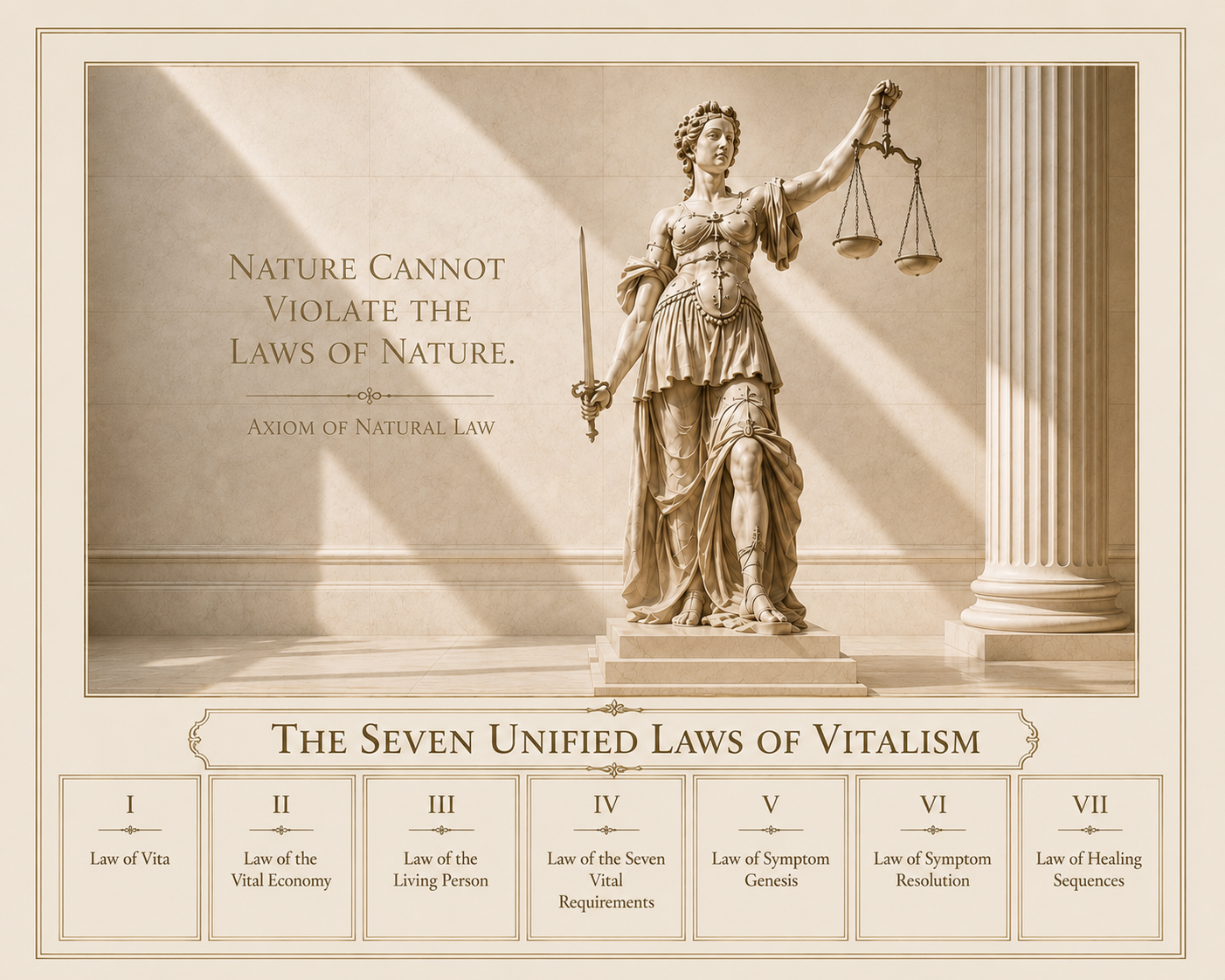
Symptoms, degeneration, adaptation, repair, and healing are expressions of this lawful biological activity. Their meaning becomes clearer when the conditions that precede them, the state of vitality, the purpose of the response, the resources available to the living body, and the sequence through which restoration proceeds are considered together. The result of centuries of observation and investigation into the action of Vita allows for their expression now as The Unified Laws of Vitalism.
Vitalism is the study of these lawful relationships and provides the natural-law foundation for the field of Health Science itself.
Vitality and the Conditions of Life
Vitalism in Action
Every living form depends upon conditions proper to its nature. In a plant, sunlight, water, nourishment from the soil, air, and appropriate temperature establish the conditions under which vitality can be expressed. As those conditions become inadequate, vitality falls and the biological economy shifts toward conservation: growth slows, flowering ceases, repair is reduced, and structure weakens.
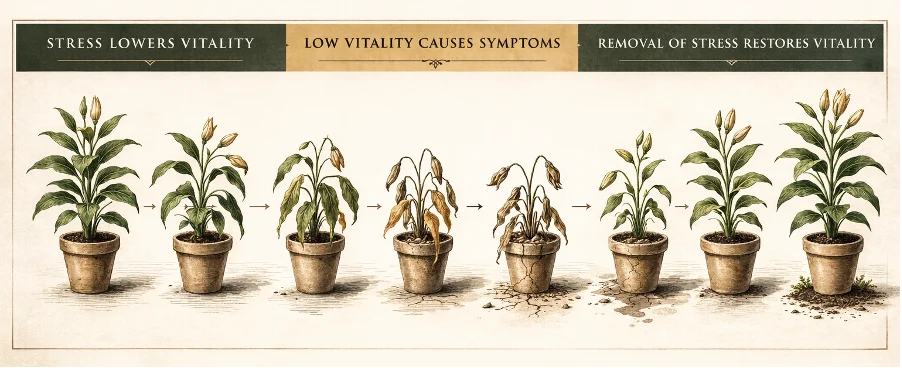
When the conditions required for the plant’s life are restored in time, vitality can rise and the same living intelligence resumes growth, repair, structural strength, and fuller expression.
The plant reveals the relationship among natural law, vitality, biological economy, degeneration, and restoration.
Human beings also depend upon definite conditions of life. The Seven Vital Requirements describe the broad conditions through which human vitality is built, diminished, and restored. They include the physical requirements shared with other living forms, the rhythms of activity and rest, the mental, emotional, and social life of the person, and the resolution of acute trauma.
Each requirement varies in degree according to constitution, temperament, age, circumstance, environment, and stage of life. Their practical fulfillment belongs to the art and science of Applied Vitalism.
The Living Person
The Whole Person Participates in Vitality
A human being is a Living Person within the biological form, possessing an interior life that includes thought, feeling, temperament, will, memory, meaning, relationships, faith, purpose, and significant experience.
Chronic mental or emotional strain diminishes and erodes vitality while acute shock to the person can initiate specific and even life-threatening biological responses. Likewise, a sense of hope, trust, love, purpose, meaningful connection, and other life-affirming states can support vitality and restoration even to the extent of overcoming what may be considered terminal conditions.
Vitalism recognizes through the third law, the Law of the Living Person, that this interior life belongs within the natural-law understanding of health.
“Every form of fear tends to depress organic energy, derange the nutritive process, produce ailments, and shorten life. […] Hence, fear is the natural and constant foe of vitality, health, longevity, and efficiency of everyone who experiences it.”
Lyman Beecher Sperry, M.D. · Dr. Chase’s Third, Last and Complete Receipt Book and Household Physician · 1884Conditions of the Body and Environment
Nutrition · Sleep · Sunlight and circadian rhythm · Movement · Rest · Metabolic health · Digestion · Detoxification · Environmental influences · Medications · Supplements · Therapies
Conditions of the Interior Life
Thought · Feeling · Temperament · Relationships · Meaning · Purpose · Faith · Stress · Significant experience · Mental and emotional life · Unresolved trauma
All of these conditions meet within one living person. Vitality, the individual’s health, is the combined effect of the whole, from the right fulfillment of the external influences to the internal.
Laboratory values, medical diagnoses, symptoms, structural patterns, traumatic events, thoughts, emotions, relationships, and personal history each provide information about the state of the person and the influences acting upon vitality. When considered together, they reveal the full condition of the individuals health.
Vitalism brings these dimensions together into the comprehensive understanding that forms the basis of Vitalistic Diagnosis.
Symptoms, Degeneration, and Healing
Symptoms Arise Within Natural Law
The Unified Laws recognize that symptoms have lawful genesis, and that their meaning depends upon the circumstances in which they arise and the biological activity taking place.
A medical diagnosis identifies and describes a recognized condition. Vitalistic inquiry continues into genesis, asking what preceded the findings, the state of vitality, what conditions surround them, what activity the living body is engaged in, and what is required for resolution.
Symptoms may participate in defense, conservation, adaptation, detoxification, repair, and restoration. Their significance becomes clearer when genesis, context, and sequence are understood.
“The so-called symptoms of disease are manifestations of an inherent principle of the organism to restore healthy function and to resist offending agents and influences.”
Herbert M. Shelton, D.P., N.D., D.N.T., D.N.Sc. · Getting Well · 1946Healing also proceeds through lawful processes. As devitalizing influences are removed, vitality is restored, trauma is resolved, and the conditions required for life are renewed, the living body can resume postponed repair and restoration according to its biological priorities.
Healing can itself be accompanied by symptoms as repair, rebuilding, remodeling, and other restorative activity proceeds. Their meaning depends upon timing, intensity, context, and the work taking place within the living body.
At moments of crisis, medical diagnosis and treatment may be essential to preserve life and maintain stability. Vitalism includes intelligent use of medical care when the condition requires it. Once stability has been secured, attention returns to vitality, the conditions of life, trauma resolution, repair, and the completion of healing processes.
2500 Years of Vitalism
The Vitalist Lineage
Across the centuries, different figures and schools developed particular parts of the vitalist understanding. Hippocrates described physis and the healing activity of nature; Hahnemann emphasized the dynamic life principle; Jennings and Trall developed physiological and hygienic approaches; Still and Palmer examined structure and nervous function; Tilden developed the concept of toxemia; Lindlahr articulated Nature Cure and the healing power within; Shelton developed Natural Hygiene; Ida Rolf advanced the study of fascia, structure, gravity, and movement; and Hamer discovered the direct correlation between types of trauma and their effects upon different systems and organs.
“Full of wonder, we can now understand for the first time that Nature is orderly and that every occurrence in Nature is meaningful, even in the framework of the whole. Nothing in Nature is meaningless, malignant or diseased.”
Ryke Geerd Hamer, M.D., Oncologist, Founder of German New Medicine, Summary of the New Medicine (2000)These observations remained distributed among separate traditions. Modern research has continued to expand knowledge of mitochondria, metabolism, aging, immunity, neurobiology, fascia, regeneration, cellular communication, trauma, epigenetics, and the biological effects of environment and behavior.
The Unified Laws of Vitalism bring these historical observations and modern discoveries into one body of natural law and one larger unified field of Applied Vitalism.
The Unified Laws of Vitalism
The Seven Unified Laws
I am the author of The Unified Laws of Vitalism, discerned from centuries of vitalistic writing and practice and informed by modern research and discovery.
The Unified Laws of Vitalism reveal that what has been called disease is the intentional and lawful activity of nature misinterpreted as pathology, and identify the lawful pathways through which symptoms arise and by which they are resolved. By revealing the true nature of disease and the natural laws of healing, they provide a unified foundation for the science of health.
The laws of nature are inviolable and do not change. What evolves is human observation and articulation of those natural processes as understanding deepens. This work represents the first, most comprehensive, and concise articulation of natural law within Vitalism. Its further evolution and refinement is entrusted to the Institute of Vitalism and its International Society of Applied Vitalism community.
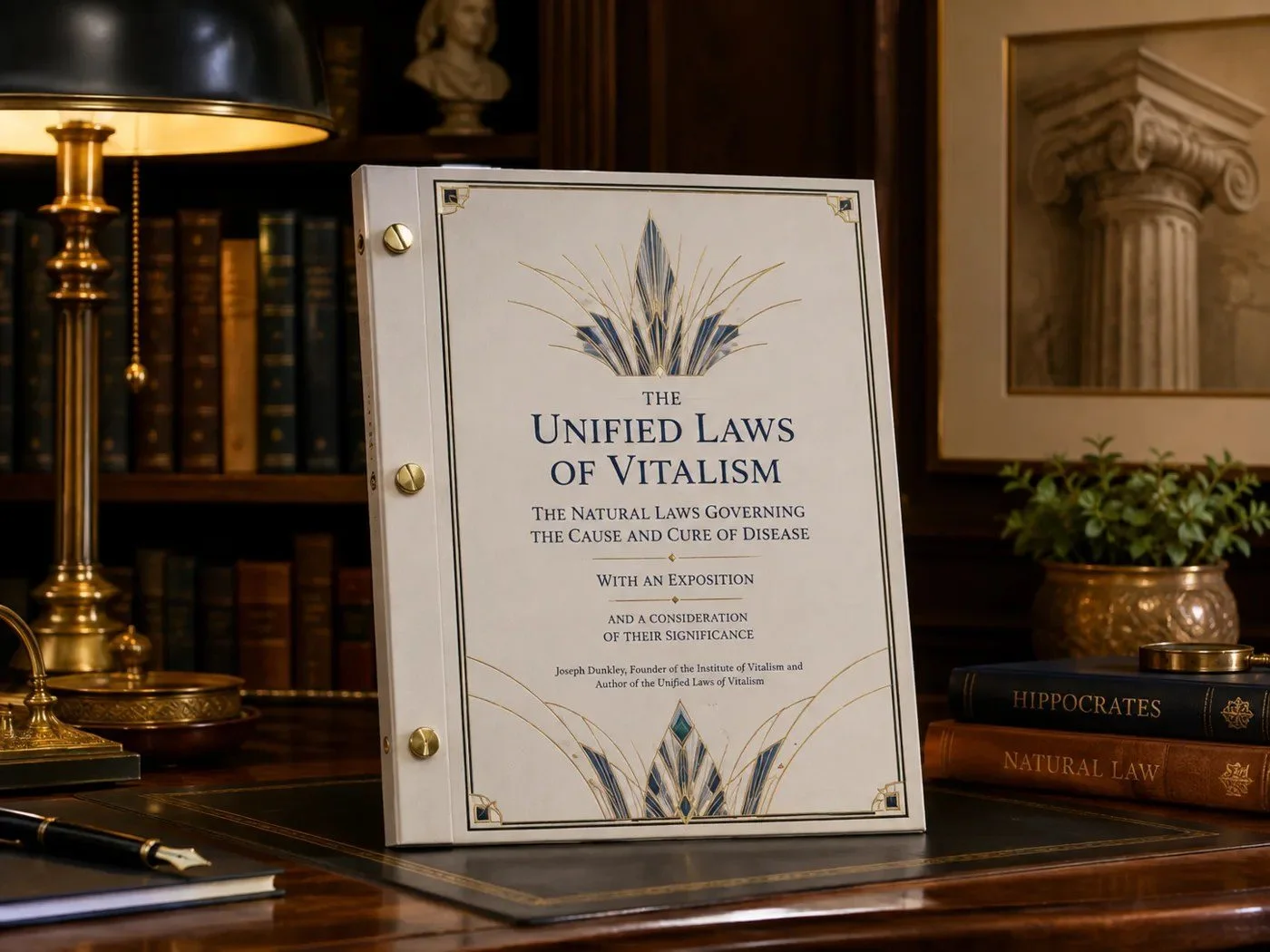
The Unified Laws of Vitalism is presently available only in a limited Private Press edition to current Valeo Therapeutics clients. Wider publication is planned for 2027.

Valeo Therapeutics
Applied in Practice
At Valeo Therapeutics, the principles and laws of Vitalism are brought into practical work with individual people through Vitalistic Naturopathy, education, health guidance, and Rolfing® Structural Integration.
Vitalistic Naturopathy applies the natural-law understanding of vitality, conditions of life, degeneration, symptoms, and restoration to the particular person. Rolfing® Structural Integration addresses the physical organization of the person through fascia, structure, movement, gravity, and function.

The Institute of Vitalism
The Institutional Home of the Field
The Institute of Vitalism exists to recover, preserve, develop, and advance the Western vitalist tradition; to steward the Unified Laws of Vitalism; to support research and education; to publish and preserve vitalistic knowledge; and to provide the scientific and philosophical foundation for the continuing development of Applied Vitalism.
The Institute places the accumulated work of the vitalist tradition into conversation with modern research and discovery, developing Vitalism as a living science grounded in observation, natural law, and the continuing study of life.
International Society of Applied Vitalism
The Community of the Field
The International Society of Applied Vitalism is the developing community through which practitioners, researchers, students, and serious health seekers can participate in the continuing growth of Applied Vitalism.
The Society provides a place for shared inquiry, case reasoning, research, clinical observation, professional fellowship, and the continuing examination and refinement of vitalistic practice under the natural-law framework of the Unified Laws of Vitalism.
Strength Through Vitalism